.png?w=128&h=128)
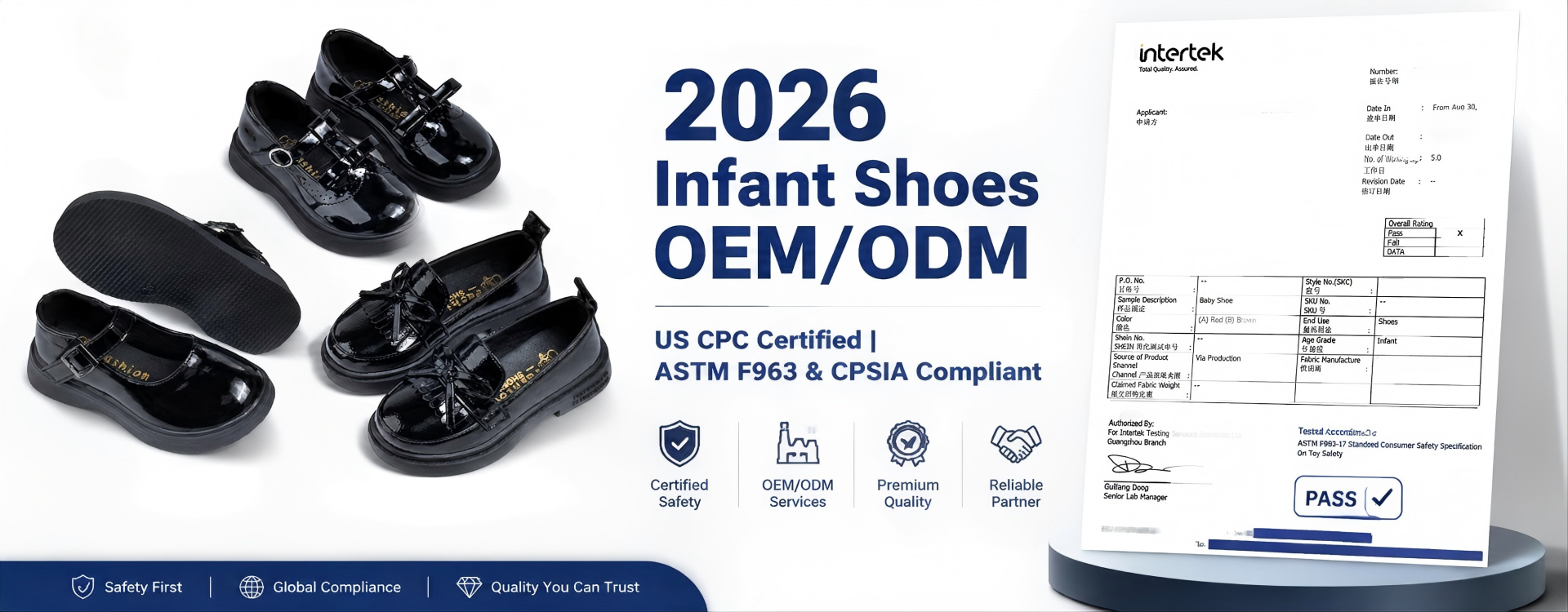
EU vs US Baby & Toddler Shoe Markets: What Every B2B Buyer Must Know Before Sourcing
By Jiezu Baby | June 2026
If you source baby kids shoes wholesale, you have likely encountered the same puzzle: a style that flies off shelves in Germany barely moves in Texas. A best-selling toddler sneaker in California gets returned in France for being "too stiff." These are not random anecdotes — they reflect deep structural differences between the European and North American children's footwear markets.
For B2B buyers — whether you run a boutique chain, manage procurement for a department store, or operate a multi-brand online platform — understanding these differences is not optional. It directly affects your inventory turnover, return rates, and margin. More importantly, it shapes which children's footwear manufacturer you should partner with and what you ask for during the sampling process.
This article breaks down the five most impactful differences between the EU and US baby and toddler shoe markets, and explains how a factory like Jiezu Baby — a dedicated B2B baby shoe supplier with deep experience serving both regions — helps buyers navigate them.
1. Safety Standards: Two Universes, One Non-Negotiable Priority
The single largest regulatory divergence between the two markets lies in safety compliance. If your supplier does not understand both frameworks, you are one shipment away from a customs hold or a product recall.
European Union: EN 71 + REACH
In the EU, children's footwear falls under the General Product Safety Regulation (GPSR), with specific chemical and physical safety requirements governed by:
- EN 71-3 — Migration of certain elements (heavy metals like lead, cadmium, chromium VI). Every material layer — upper textile, lining, insole, outsole, and any applied decoration — must be tested separately.
- REACH (EC 1907/2006) — Registration, Evaluation, Authorisation and Restriction of Chemicals. This regulation restricts over 200 substances of very high concern (SVHCs), including phthalates, azo dyes, and formaldehyde. Baby shoes, given the high likelihood of mouth contact, face the strictest thresholds.
- EN 14682 — Safety of children's clothing, including cords and drawstrings. For baby shoes, this applies primarily to decorative laces, elastic cords, and any detachable small parts that could pose a choking hazard.
The practical implication: EU-bound baby shoes require full material traceability documentation. Every buckle, every stitch thread, every printed logo — you need to know the chemical composition and have test reports ready before the goods ship.
United States: CPSIA + ASTM F963
The US framework is built around the Consumer Product Safety Improvement Act (CPSIA):
- Total lead content: Surface coatings ≤ 90 ppm; substrates ≤ 100 ppm.
- Phthalates: DEHP, DBP, BBP, DINP, DIDP, DnOP, DIBP, DPENP, DHEXP, DCHP — each permanently banned above 0.1% in children's products.
- ASTM F963: While primarily a toy standard, it applies to footwear with toy-like features (light-up soles, character appliqués, sound modules).
- Third-party testing at CPSC-accredited labs is mandatory. A General Certificate of Conformity (GCC) must accompany every shipment, backed by test reports no older than one year for each production batch.
What This Means for Sourcing
The overlap is real — but so are the gaps. A shoe that passes CPSIA does not automatically clear REACH, and vice versa. That is why working with a toddler shoes factory that maintains dual compliance documentation, rather than one that treats EU and US as "roughly the same," saves weeks of back-and-forth during pre-shipment inspection.
Related reading: Complete Guide to Baby Shoe Safety Standards for Importers
2. Design Aesthetics: European Restraint Meets American Boldness
Walk a European trade show (Pitti Bimbo, Kind + Jugend) and an American one (Magic, Children's Club) back-to-back, and you will notice the aesthetic gap within the first five minutes.
European Preferences
European baby shoe design leans toward:
- Muted, earthy palettes: Dusty pink, sage green, oat, camel, slate grey, and cream dominate. Bright neon and saturated primaries are rare.
- Clean silhouettes: Minimal stitching, no oversized logos, no character licensing. The shoe itself — its shape and material quality — is the brand message.
- Leather-first mentality: In markets like Germany, France, Italy, and Scandinavia, parents strongly prefer genuine leather uppers and linings for breathability and foot health. A synthetic upper on a €35+ baby shoe is a hard sell.
- Unisex styling: A growing portion of the market prefers gender-neutral designs, driven by sustainability-minded Millennial and Gen Z parents who plan to pass shoes between siblings.
US Preferences
The American market embraces:
- Bold, high-contrast colorways: Bright red, electric blue, hot pink, neon green. Color is a selling point in itself.
- Character licensing and graphics: Licensed properties (Disney, Marvel, Paw Patrol) and playful prints (dinosaurs, unicorns, trucks) drive significant volume, especially in the $15-35 retail bracket.
- Athleisure influence: Even for infants and toddlers, sneaker-style silhouettes — complete with chunky soles, mesh panels, and sport-logo detailing — outsell traditional Mary Janes and lace-ups.
- Seasonal thematic drops: Holiday-specific designs (Halloween pumpkins, Christmas plaids, Easter pastels) are a legitimate sales driver that many European buyers treat as niche.
The Factory Capability Question
A supplier that only excels at one aesthetic will struggle to serve the other. Jiezu Baby's sample room maintains separate design libraries for EU and US clients: one side stocked with full-grain leathers in muted tones and clean lasts; the other with certified-print fabrics, character-appliqué tooling, and EVA-composite soles in bright colorways. This dual capability means B2B buyers do not need to split their order book across two factories.
3. Sizing Systems & Foot Shape: Not Just a Conversion Chart
If you have ever tried to map EU size 22 directly to US size 6 and been surprised by the fit, you are not alone. The sizing divergence is more than a unit conversion — it reflects genuine anthropometric differences.
The Sizing Frameworks
But conversion alone misses the point. European children's feet, on average, are narrower in the heel and higher in the instep compared to North American children's feet. A US-market shoe built on a European last will feel tight across the ball; an EU-market shoe built on a US last will slip at the heel.
Practical B2B Implications
- Last development cost: A factory that only owns EU-standard shoe lasts (and there are many) cannot properly fit the US market without investing in a new set — typically $800-2,000 per size per style. Spread across 8 toddler sizes and 6 styles, that is a six-figure tooling investment.
- Return rate sensitivity: US online footwear return rates are 5-8 percentage points higher than EU, and fit/sizing accounts for roughly 60% of those returns. If your supplier's US lasts are just EU lasts with a converted label, your return rate will reflect that.
- Width offering strategy: UK buyers in particular expect width fittings (standard/wide) as a baseline. US buyers are increasingly demanding wide options for toddlers. EU buyers generally accept a single width if the last is well-designed.
Jiezu Baby's last library includes region-specific lasts for EU, UK, and US markets, developed through fit-testing panels in each target region. For B2B buyers launching a new private-label line, this eliminates the most expensive and time-consuming step in product development.
Related reading: How to Choose the Right Children's Shoe Manufacturer: A 10-Point Checklist
4. Seasonal Buying Cycles: The Calendar Gap That Surprises New Importers
The procurement calendar does not align across the Atlantic. A B2B buyer who assumes the EU and US seasons run on the same clock will mis-time their orders by 4-8 weeks — enough to miss a full selling window.
Key Seasonal Differences
What This Means for Your Production Schedule
If you are a B2B baby shoe supplier working with a single factory, the May-June period is your choke point: EU FW orders and US BTS orders hit the production line simultaneously. Factories that do not plan for this either extend lead times or rush quality control — both of which hurt the buyer.
Experienced manufacturers manage this through:
- Capacity reservation: Allocating production line slots 6-9 months in advance for recurring clients.
- Pre-booked material inventory: Stocking high-demand leathers, soling sheets, and hardware before the peak window opens.
- Staggered QC scheduling: Running EU and US inspection batches on parallel tracks rather than a single queue.
When evaluating a potential manufacturing partner, ask how they managed their last May-June production window. Their answer will tell you more than any factory tour.
5. Material Preferences & Sustainability: A Growing Divide
Both markets are moving toward sustainability, but they are moving in different directions and at different speeds.
EU: Regulation-Driven Sustainability
The EU is building a regulatory architecture that will fundamentally reshape children's product manufacturing:
- Digital Product Passport (DPP) — Mandatory for textiles and footwear under the Ecodesign for Sustainable Products Regulation (ESPR), rolling out from 2027-2030. Every shoe will need a scannable digital record of its materials, manufacturing location, recyclability, and environmental footprint.
- Green Claims Directive — Bans vague claims like "eco-friendly" or "green" without verified evidence. A shoe labeled "made with recycled materials" must specify the exact percentage and type.
- EU Deforestation Regulation (EUDR) — Requires proof that leather does not come from recently deforested land. Full traceability to the slaughterhouse level is becoming table stakes.
- Microplastic restrictions — Proposed bans on intentionally added microplastics will affect synthetic leathers, glitter coatings, and certain sole materials.
For B2B buyers serving EU retailers, documentation is becoming as important as the product itself. Retailers like Zalando, About You, and major department stores now require sustainability data fields in their vendor onboarding forms, and missing data can block listings.
US: Consumer-Led Sustainability
The US lacks a comparable federal regulatory push, but consumer demand — particularly from Millennial and Gen Z parents — is driving change:
- Material claims matter at shelf: "Recycled PET upper," "organic cotton lining," and "plant-based foam insole" are becoming purchase triggers for an estimated 35-40% of US baby product buyers.
- Brand-level transparency: DTC brands like Ten Little and See Kai Run have built brand equity on material transparency, setting an expectation that wholesale brands and private labels now need to meet.
- Voluntary certifications: OEKO-TEX Standard 100, GOTS (Global Organic Textile Standard), and the Leather Working Group (LWG) rating carry weight in US marketing even without legal mandates.
The Factory's Role
A children's footwear manufacturer aiming to serve both markets needs:
- A documented material supply chain that can support EU DPP requirements.
- Access to certified sustainable materials (LWG-rated leather, GRS-certified recycled polyester, FSC-certified packaging).
- In-house testing capability to verify material composition claims before the goods leave the factory — because a claim printed on a box must be provable, not aspirational.
Jiezu Baby has invested in both material traceability systems and a supplier qualification program that pre-vets raw material sources against both EU and US sustainability expectations. For B2B buyers building an "eco-collection" or responding to a retailer's sustainability mandate, this infrastructure is already in place.
How Jiezu Baby Bridges Both Markets
Serving the EU and US markets from one factory is not about finding a "middle ground" design that pleases neither. It is about building parallel capabilities:
- Separate last libraries for EU, UK, and US foot shapes.
- Dual compliance documentation maintained per SKU, per market.
- Two design direction tracks in the sample room, each informed by seasonal trend reports from that region.
- Production planning that accounts for the EU-US calendar offset and reserves capacity accordingly.
- Material traceability infrastructure ready for EU DPP requirements and US brand-transparency expectations.
For B2B buyers, working with a factory that genuinely understands both markets means one fewer headache. You brief one team, you get one quality standard, and you receive one consolidated shipment — but your products work on both sides of the Atlantic because the development was done right from the start.
Your Next Step
Whether you are:
- A US-based retailer looking to launch a private-label baby shoe line that meets CPSIA standards with European-quality finishing,
- A European distributor sourcing baby kids shoes wholesale from Asia and needing a factory that already has REACH-compliant material documentation,
- Or a multi-region e-commerce brand that needs one toddler shoes factory to serve both your .com and .de storefronts,
Jiezu Baby is ready to talk.
Our MOQ starts at 300 pairs per style, with flexible customization across materials, colors, lasts, and packaging. We ship to major ports in North America and Europe, with third-party inspection reports available on every order.
Contact Jiezu Baby today:
- Website: babykidshoes.com
- Email: info@babykidshoes.com
- Showroom visits: Available by appointment at our Fujian, China headquarters
Request a sample kit and see the EU-US quality difference for yourself. Tell us which market you are targeting, and we will prepare a curated sample set with the right lasts, materials, and compliance documentation for your region.
More insights for B2B buyers: