.png?w=128&h=128)
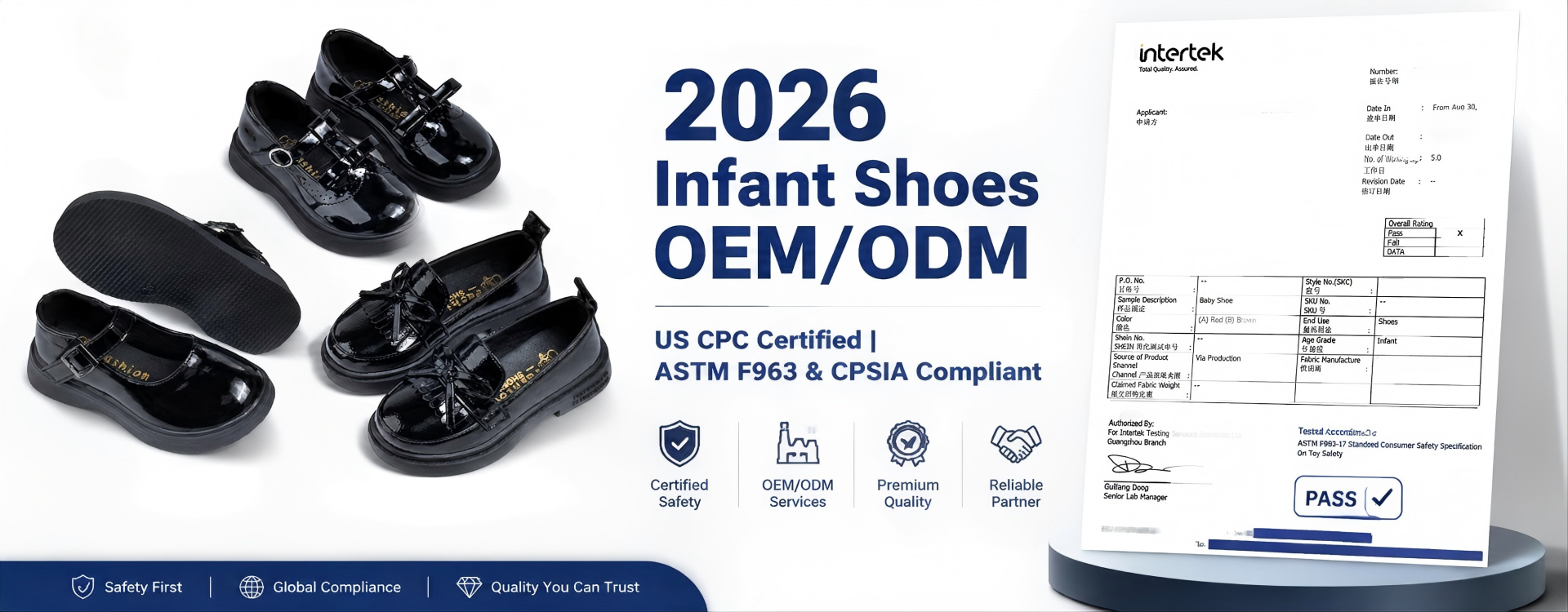
US vs. EU Baby Shoe Markets: A B2B Sourcing Guide for Children's Footwear Buyers
Key differences in sizing standards, material regulations, design preferences, and seasonal buying patterns — and how the right manufacturer can help you navigate both.
Introduction: Two Markets, One Supplier Challenge
The global children's footwear market is projected to exceed $60 billion by 2028, with the United States and the European Union accounting for over 45% of total import demand. For B2B buyers sourcing baby shoes wholesale, these two regions represent the most lucrative — and the most challenging — markets to serve simultaneously.
The challenge is not simply one of logistics or tariffs. The US and EU markets diverge fundamentally in four critical areas: sizing standards, material safety regulations, aesthetic preferences, and seasonal buying calendars. A product line that sells well in Dallas may fail compliance testing in Düsseldorf. A collection that resonates with parents in Paris may feel underwhelming to buyers in Chicago. For procurement managers and wholesale distributors, understanding these differences before placing a children's footwear manufacturer order is the difference between profitable inventory and costly write-offs.
At Jiezu Baby (babykidshoes.com), a specialized B2B baby shoes manufacturer based in China, we have spent over a decade helping international buyers navigate this transatlantic divide. Our factory operates dual-standard production lines precisely because we understand that a one-size-fits-all approach does not work in children's footwear. This guide distills our cross-market sourcing experience into actionable insights for wholesale buyers, category managers, and importers who need their baby shoe supplier China orders to perform equally well on both sides of the Atlantic.
For a broader overview of how to evaluate factory partners, see our earlier article: How to Choose the Right Baby Shoe Manufacturer: 10 Questions Every Buyer Should Ask.
1. Sizing Standards: The Hidden Conversion Trap
The Two Systems at a Glance
The first and most operationally significant difference between US and EU markets is the sizing system. North American retailers use the US Children's sizing scale (0-13, then 1-7 for youth), while European retailers follow the EU sizing system based on foot length in centimeters with Paris point increments (6.67 mm per size). A US size 5 toddler shoe does not equal an EU size 20, and assuming equivalence without proper conversion tables leads to high return rates and frustrated retail partners.
| Age Group | US Size Range | EU Size Range | Foot Length (cm) |
|---|
| Newborn (0-6m) | 0-2 | 15-17 | 8.3–10.2 |
| Infant (6-12m) | 2-4 | 17-19 | 10.2–11.6 |
| Toddler (1-3y) | 4-7 | 19-23 | 11.6–14.3 |
| Little Kid (3-5y) | 7-10 | 23-27 | 14.3–16.8 |
| Big Kid (5-8y) | 10-13 | 27-31 | 16.8–19.5 |
The Real-World Impact on B2B Orders
For wholesale buyers, the sizing gap introduces three layers of complexity:
Layer 1: SKU multiplication. A single design may require 10-12 size variations for the US market but 12-14 for the EU market, with only partial overlap. When a buyer wants the same collection for both regions, they often need 16-18 distinct sizes per design — nearly double the initial assumption.
Layer 2: Labeling and packaging. US regulations require size labeling in US format; EU regulations mandate EU sizing plus centimeter measurement under EN 14602. Dual-market packaging must accommodate both, increasing per-unit packaging costs by an estimated 8-12% unless the manufacturer already has dual-labeling capability — a feature our production planning guide covers in Production Planning for Multi-Region Baby Shoe Orders.
Layer 3: Fit tolerance differences. European feet tend to be slightly narrower on average than American feet in the same age group. A last designed for the US market may fit too loosely for EU consumers, and vice versa. Serious kids footwear sourcing buyers should request region-specific last data from their manufacturer before committing to production.
Jiezu Baby's approach: We maintain separate US and EU last libraries developed from anthropometric data across both regions. When a buyer places a dual-market order, we produce from the appropriate last for each destination — same upper design, region-optimized fit.
2. Material Safety & Regulations: Non-Negotiable Compliance
If sizing is the operational challenge, material compliance is the existential one. Both the US and EU impose strict safety regulations on children's products, but the specific requirements differ in ways that can catch even experienced importers off guard.
US Requirements: CPSIA and ASTM F963
The Consumer Product Safety Improvement Act (CPSIA) governs all children's products sold in the United States. Key requirements for baby shoes include:
- Lead content: Maximum 100 ppm in accessible substrate materials; 90 ppm in surface coatings.
- Phthalates: Maximum 0.1% for six restricted phthalates (DEHP, DBP, BBP, DINP, DIDP, DnOP) in any accessible component.
- Third-party testing: Mandatory CPSC-accepted laboratory testing with Children's Product Certificate (CPC) issuance.
- Tracking labels: Permanent, legible tracking information on each product and packaging.
The ASTM F963 standard adds further requirements around small parts, sharp edges, and flammability — particularly relevant for shoes with decorative elements, appliqués, or light-up features, which are increasingly popular in children's footwear.
EU Requirements: REACH and EN 71-3
The European framework is anchored by REACH (Registration, Evaluation, Authorisation and Restriction of Chemicals) and the toy safety standard EN 71-3, which applies to footwear marketed to children under 36 months:
- REACH restricted substances: Over 200 substances with specific concentration limits, including a broader phthalate restriction (four phthalates at 0.1% individually) plus restrictions on DMFu (dimethylfumarate), which caused a major children's shoe recall in 2008 and remains a high-scrutiny substance.
- EN 71-3 migration limits: For shoes targeting children under 36 months, EN 71-3 sets migration limits for 19 elements (including aluminum, antimony, arsenic, barium, boron, cadmium, chromium, cobalt, copper, lead, manganese, mercury, nickel, selenium, strontium, tin, organic tin, and zinc), tested under simulated gastric fluid conditions — a fundamentally different testing methodology from CPSIA's total content approach.
- CE marking: Mandatory for all products placed on the EU market, backed by a Declaration of Conformity and technical documentation file.
The Crucial Overlap and Divergence
While both frameworks aim to protect children, a product that passes CPSIA does not automatically pass REACH/EN 71-3, and vice versa. The testing methodologies differ (total content vs. migration limits), the substance lists overlap only partially, and documentation requirements follow completely different formats. For a deeper dive into navigating certification and lab testing, see Your Complete Guide to Children's Shoe Safety Certifications.
Buyer takeaway: If you plan to sell in both markets, request material formulations tested against both CPSIA and REACH/EN 71-3 from your baby shoe supplier China. At Jiezu Baby, all our raw material inputs — from leather and textiles to adhesives and dyes — are sourced from suppliers who provide dual-compliance certification, and we conduct batch-level third-party testing at Intertek and SGS facilities before shipment release.
3. Design & Color Preferences: Two Aesthetic Worlds
Beyond technical specifications, B2B buyers must contend with fundamentally different design expectations between American and European consumers. These preferences influence everything from color palette selection to material choices and decorative detailing.
The American Market: Bold, Character-Driven, and Seasonal
US consumers gravitate toward:
- Vibrant, saturated colors: Bright primaries (red, blue, yellow), hot pink, neon accents, and strong contrasts dominate mass-market children's footwear. Gender-differentiated colorways (pink for girls, blue for boys) remain the retail norm in the US, though gender-neutral options are growing.
- Character and novelty motifs: Licensed characters (Disney, Marvel, cartoon figures) account for a significant share of US baby shoe sales. Animal faces, vehicle motifs, and whimsical patterns with bold outlines are strong sellers.
- Seasonal theming: Holiday-specific collections (Halloween pumpkins, Christmas reindeer, Easter bunnies, Fourth of July stars) drive significant seasonal revenue. B2B buyers ordering wholesale toddler shoes for the US market should plan for at least four seasonal drops per year: Spring, Summer/Back-to-School, Fall/Halloween, and Holiday/Winter.
The European Market: Understated, Natural, and Design-Led
European parents consistently prefer:
- Muted, earthy palettes: Sage green, ochre, dusty pink, oatmeal, charcoal, and soft pastels dominate. Even when color is present, it tends toward desaturated and sophisticated tones rather than primaries.
- Minimalist, gender-neutral design: Scandinavian-influenced clean lines, solid colors, simple geometric patterns, and nature-inspired motifs (leaves, clouds, subtle animals) are the consistent best-sellers across Northern and Western Europe. Overt gender coding through color is increasingly rejected by European consumers.
- Material-forward aesthetics: European buyers place premium value on visible material quality — genuine leather, organic cotton linings, wool felt, and natural rubber soles. The material itself is often the design statement, with minimal additional decoration.
- Year-round collections: While seasonal shifts exist, the European market favors fewer but more cohesive year-round collections rather than frequent holiday-driven micro-drops.
Reconciling the Two for Dual-Market Production
The best strategy for dual-market B2B buyers is to commission a shared base design with region-specific colorway and detailing variations. For example, a classic T-bar first walker shoe can be produced in navy, blush, and oatmeal for the EU market, and in royal blue, hot pink, and red with star appliqué for the US market — using the same pattern, same sole unit, and same production setup. We discuss this approach in detail in How to Design One Collection for Multiple Markets.
4. Seasonal Buying Calendar: Timing Is Everything
The US and EU retail calendars do not align, and B2B buyers who treat them as interchangeable miss critical ordering windows.
US Seasonal Buying Rhythm
| Season | Order Window | In-Store Period | Key Drivers |
|---|
| Spring Collection | Sep-Oct (prior year) | Feb-Apr | Easter, spring break, new season |
| Summer / BTS | Jan-Feb | May-Aug | Summer holidays, Back-to-School (Jul-Aug peak) |
| Fall / Halloween | Apr-May | Sep-Oct | Halloween, autumn transition |
| Holiday / Winter | Jun-Jul | Nov-Jan | Christmas, Thanksgiving, gift season |
US retailers typically operate on a 4-6 month lead time from order placement to shelf. The Back-to-School season (July-August) is the single largest selling window for children's footwear in the US, accounting for roughly 30% of annual category sales.
EU Seasonal Buying Rhythm
| Season | Order Window | In-Store Period | Key Drivers |
|---|
| Spring/Summer | Oct-Nov (prior year) | Mar-Jun | New season collection, Easter (varies by country) |
| Summer Sale / Transition | Feb-Mar | Jul-Aug | Summer holidays, transitional styles |
| Autumn/Winter | May-Jun | Sep-Dec | Back-to-school (varying Sep dates), autumn transition |
| Winter / Holiday | Jul-Aug | Nov-Jan | Christmas markets, winter holidays |
European buying cycles tend to start slightly later but feature longer in-store periods. The peak children's shoe purchasing window in Europe is more evenly distributed across spring (March-May) and autumn (September-October), with less concentration around a single Back-to-School event compared to the US.
Procurement Implication
A B2B buyer sourcing baby shoes wholesale for both markets needs to place production orders on the EU calendar while simultaneously planning US seasonal drops — meaning their production partner must be capable of staggered, continuous production rather than single-batch manufacturing. At Jiezu Baby, we support rolling production schedules with 4-6 week replenishment cycles, allowing buyers to phase regional inventory without overstocking.
5. How Jiezu Baby Supports Dual-Market Buyers
After years of serving wholesale clients across North America and Europe, we have built our factory infrastructure around the specific needs of dual-market buyers. Here is how that translates into operational advantage:
Dual-Standard Production Lines
We maintain separate production tracks for US-bound and EU-bound orders within the same facility. Each track uses region-specific lasts, material formulations, labeling protocols, and packaging specifications. This eliminates the risk of cross-contamination between regulatory regimes — a concern that generic factories cannot adequately address.
Flexible MOQ with Region Splitting
Our standard minimum order quantity is 300 pairs per design, but we allow region splitting: 150 pairs for the US and 150 for the EU of the same design, each produced to its respective standard and shipped separately. This structure enables mid-sized wholesale buyers to test both markets without doubling their MOQ commitment.
Pre-Compliance Material Library
All raw materials in our supply chain — leathers, textiles, EVA compounds, rubber, adhesives, dyes, and accessories — are pre-screened against both CPSIA and REACH/EN 71-3 restricted substance lists. When a buyer specifies "dual-market compliance," we select exclusively from materials with dual-certification, eliminating the need for reformulation between orders and accelerating time-to-market.
Integrated Quality Control
Every production batch undergoes three inspection gates: incoming material inspection (IQC), in-process quality control (IPQC) at 30% and 70% completion, and final random inspection (FRI) per AQL 2.5/4.0 standards. For dual-market orders, we conduct parallel testing — one sample to an ASTM-specialized lab, another to an EN 71-3-specialized lab — ensuring neither market's compliance is an afterthought.
In-House Design Support
Our design team can adapt a single product concept into US and EU variants — adjusting colors, details, and packaging — at no additional design cost for orders above 600 pairs per design. This service reduces the creative burden on buyers who do not maintain in-house design teams for both markets.
6. Conclusion: The Right Partner Makes the Difference
Sourcing children's footwear for both the US and EU markets is not twice the work — it is a fundamentally different kind of work. The sizing systems do not align. The regulatory frameworks test for different substances using different methodologies. Consumer expectations around color, design, and material diverge meaningfully. And the buying calendars, while overlapping, follow distinct rhythms that demand flexible production planning.
Yet the opportunity for B2B buyers who get it right is substantial. Retailers and distributors that can serve both markets with compliant, well-designed, appropriately sized product capture a larger share of global demand and insulate their business from single-market downturns. The key is partnering with a children's footwear manufacturer that has already invested in the dual-standard infrastructure, dual-compliance material sourcing, and dual-market production expertise required.
At Jiezu Baby, that is exactly what we have built.
Partner with Jiezu Baby
Whether you are a wholesale distributor, retail chain buyer, or private-label brand owner, we are ready to support your US, EU, or dual-market sourcing needs.
Jiezu Baby (babykidshoes.com) — Your Trusted B2B Baby Shoe Manufacturer
- Website: www.babykidshoes.com
- Email: info@babykidshoes.com
- WhatsApp / WeChat: Available for real-time inquiries — contact us to connect
- MOQ: Starting from 300 pairs per design, with region-splitting options
- Sampling: Custom samples delivered within 10-14 business days
- Customization: OEM/ODM, private labeling, dual-market packaging, and full design support
Ready to discuss your next collection? Reach out today for a personalized consultation, factory tour (virtual or in-person), and complimentary material compliance briefing tailored to your target markets. Let us help you navigate the US-EU divide — one perfectly sized, fully compliant pair at a time.
Explore more insights from our sourcing series: