.png?w=128&h=128)
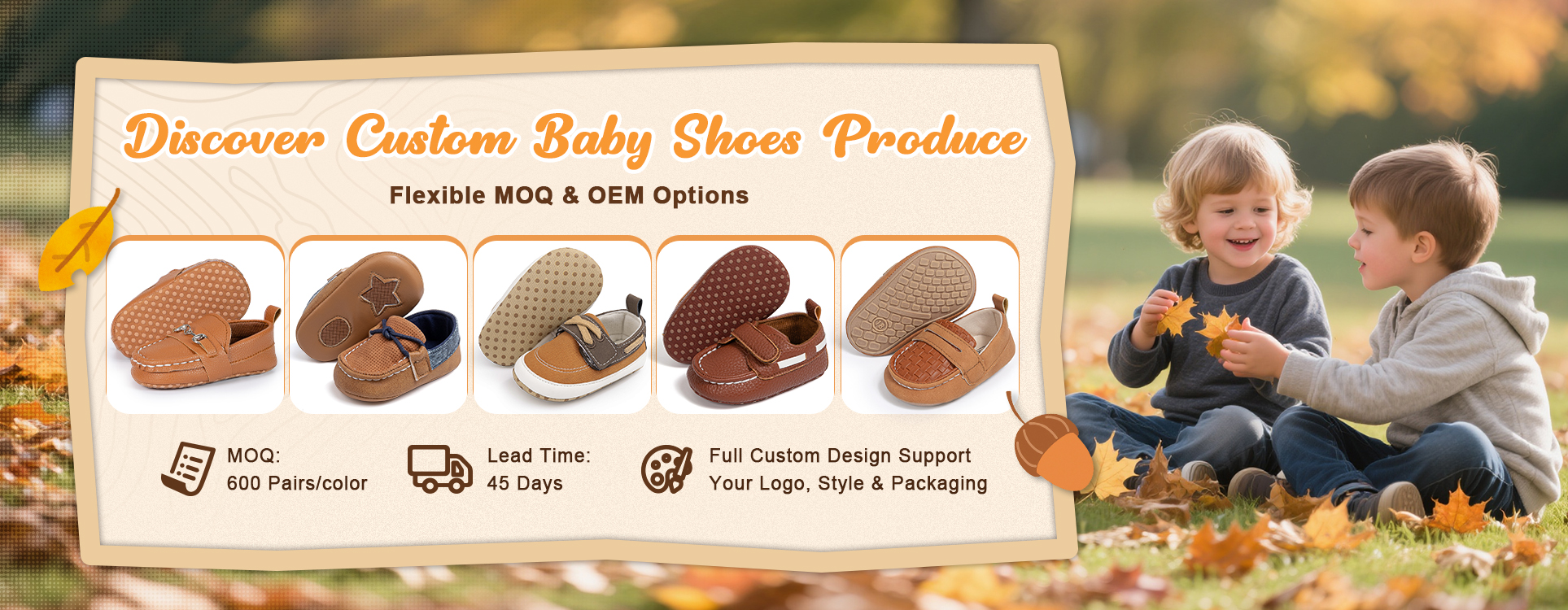
Understanding MOQ in the Baby Shoe Industry: A Complete Guide for B2B Buyers
Minimum Order Quantity — three words that can make or break a procurement decision. Whether you are a first-time importer testing the waters or a seasoned distributor scaling into new markets, MOQ is one of the first questions you will ask a baby shoe manufacturer. Yet many B2B buyers misunderstand how MOQ works, why it exists, and most importantly, how to negotiate it effectively.
This guide breaks down everything you need to know about MOQ in the baby footwear industry, with actionable strategies to help you secure terms that align with your business goals.
What Is MOQ and Why Does It Matter?
MOQ stands for Minimum Order Quantity — the smallest number of units a supplier is willing to produce or sell in a single purchase order. For baby shoe buyers, MOQ affects multiple dimensions of your business:
- Cash flow: Higher MOQs mean larger upfront capital commitments. A MOQ of 1,000 pairs at $3.50/pair requires $3,500 before freight, duties, and warehousing costs.
- Inventory risk: Over-ordering on untested styles or sizes can leave you with slow-moving stock, especially in the baby footwear segment where size ranges are critical.
- Speed to market: Lower MOQs allow you to test new designs faster and iterate based on customer feedback.
- Supplier access: Some premium manufacturers simply will not entertain orders below their threshold, limiting your sourcing options.
Understanding MOQ is not just about finding the lowest number — it is about finding the right balance between cost, quality, and supply chain flexibility.
Why MOQ Exists in the Baby Shoe Manufacturing Process
Before you push back on a supplier's MOQ, it helps to understand why it exists. Baby shoe manufacturing is not plug-and-play. Here is what goes into every production run:
1. Material Procurement
Leather, textile, rubber soles, EVA foam, buckles, snaps — these materials are purchased in bulk rolls or batches. A factory cannot buy 2 square meters of leather for a single pair of baby shoes. They buy entire hides. For cotton canvas uppers, fabric mills impose their own minimums, often 100–500 meters per color. If you want a custom color, that minimum applies to you.
2. Mold and Tooling Costs
Rubber soles require metal molds. Each size (EU 16 through EU 28 for toddlers, for example) may need its own mold set. A single sole mold can cost $200–$800 depending on complexity and material. Multiply that by 6–8 sizes per style, and you begin to see why factories need volume to amortize these costs.
3. Production Line Setup
Switching a production line from one style to another takes time. Workers must be retrained on the new pattern, machines must be recalibrated, and quality control checkpoints must be re-established. A factory producing 50 pairs of a new style loses money on the switchover alone. They need enough volume to justify the downtime.
4. Quality Control and Compliance
Reputable baby shoe manufacturers invest in testing — CPSIA compliance for the US market, EN 71-3 for Europe, and REACH regulations for chemical substances. These tests cost money per batch. Spreading that cost across 200 pairs versus 2,000 pairs changes your per-unit cost dramatically.
5. Packaging and Labeling
Custom packaging (shoe boxes, hang tags, barcode stickers, care labels) all have their own minimum print runs. A custom box order might start at 500–1,000 units. If your MOQ is 300 pairs, the factory either absorbs excess packaging cost or passes it to you.
Typical MOQ Ranges in Baby Footwear by Product Type
MOQ varies significantly based on product complexity, material cost, and customization level. Here is a realistic breakdown for baby shoe categories:
| Product Type | Material Complexity | Typical MOQ (Per Style/Color) | Notes |
|---|
| Pre-walker soft sole (leather) | Low–Medium | 200–500 pairs | Fewer components, simpler construction |
| Canvas crib shoes | Low | 200–300 pairs | Fabric-based, easier to produce |
| Toddler sneakers (textile + rubber sole) | Medium | 300–600 pairs | More parts, stitching complexity |
| Toddler sneakers (leather + rubber sole) | High | 500–1,000 pairs | Premium materials, longer production time |
| Leather first-walker shoes | Medium–High | 300–500 pairs | Requires skilled stitching |
| Sandals (summer styles) | Low–Medium | 300–500 pairs | Seasonal demand affects pricing |
| Winter boots (fleece-lined) | High | 500–800 pairs | Multiple material layers, heavier |
| Fully custom design (your sole, your pattern) | High | 800–1,500+ pairs | Tooling costs dominate |
Key takeaway: If your business model relies on small-batch testing (50–100 pairs per style), you need a supplier that explicitly offers low-MOQ programs or stock-lot purchasing options. Standard ODM/OEM production almost always starts higher.
Low MOQ vs. High MOQ: The Trade-offs
Many B2B buyers fixate on finding the lowest possible MOQ. But low MOQ is not always the best deal. Here is a side-by-side comparison:
| Factor | Low MOQ (50–300 pairs) | High MOQ (500–2,000+ pairs) |
|---|
| Unit Price | Higher per-pair cost | Significant volume discount (15%–40% lower) |
| Customization | Limited — stock materials only | Full custom — your colors, materials, branding |
| Production Priority | Lower — may be queued behind large orders | Higher — dedicated production slots |
| Quality Consistency | Can vary — smaller runs may get less QC attention | More consistent — standardized process |
| Shipping Cost per Unit | Higher — less efficient container utilization | Lower — full container load (FCL) savings |
| Cash Outlay | Lower total spend | Higher total spend, better ROI per unit |
| Risk | Lower inventory risk | Higher inventory risk, especially for new designs |
The sweet spot for most growing B2B buyers is in the middle tier: 300–500 pairs per style. This range unlocks moderate volume pricing while keeping inventory manageable. For more on balancing cost and quality, see our detailed guide to sourcing reliable baby shoe manufacturers.
How to Negotiate MOQ with Baby Shoe Suppliers
MOQ is rarely a hard line. Experienced B2B buyers know that negotiation is less about demanding a lower number and more about structuring a deal that works for both sides. Here are proven tactics:
1. Start with a Trial Order
Frame your first order as a "trial run" with the explicit understanding that larger volumes will follow. Be specific: "We plan to start with 200 pairs to test market response, with an estimated reorder of 800 pairs within 60 days if the style performs." Suppliers are more willing to bend on MOQ when they see a path to repeat business.
2. Consolidate Styles, Not Colors
If your target is 300 pairs but the MOQ is 500, ask if you can split across 2–3 styles while keeping the same sole unit. This reduces the factory's mold and material costs per style while giving you the variety you need.
3. Accept a MOQ Surcharge
Some factories will accept a below-MOQ order if you pay a surcharge (typically 10%–20% on top of the standard unit price). This covers their fixed production costs. Run the math: paying $3.85/pair for 300 pairs ($1,155) versus $3.20/pair for 500 pairs ($1,600). If the extra 200 pairs would sit in your warehouse, the surcharge route saves you $445 in total cash outlay.
4. Use Stock Materials
Custom colors and custom materials are the biggest MOQ drivers. Ask the factory what materials they already stock. If you can design within their existing color palette, MOQ often drops by 30%–50%.
5. Bundle with Complementary Products
If you also need baby socks, bibs, or accessories from the same factory group, bundle them into one purchase order. A combined order of 800 units across product lines may meet the factory's volume threshold even if each individual category falls below.
6. Time Your Order Strategically
Factories have slow seasons. In China, the period after Chinese New Year (February–March) and the summer lull (July–August) often see factories more willing to accept smaller orders to keep lines running. Ask your supplier about their production calendar.
For a deeper dive into factory vetting and negotiation strategies, read our comprehensive guide on finding trustworthy baby shoe factories.
MOQ Considerations for Different Business Models
Your ideal MOQ depends heavily on your go-to-market strategy. Here is how different B2B models typically approach MOQ:
Drop-shipping and Print-on-Demand
If you operate a drop-shipping model, MOQ is effectively irrelevant — your supplier ships individual pairs directly to your end customers. However, this model severely limits branding, packaging customization, and margin. Most B2B buyers use drop-shipping as a market-testing phase before transitioning to bulk purchasing. To understand the full picture, check out our analysis of the baby shoe drop-shipping model.
Boutique Retail (1–3 Stores)
You need variety but cannot absorb large inventory. Target suppliers with MOQs of 100–300 per style, or seek out manufacturers that offer mixed-style orders. The key is to find a partner willing to grow with you.
Regional Distribution (Wholesale)
Serving multiple retail accounts across a region requires consistent stock. MOQs of 500–1,000 per style are more appropriate here, as you need depth in each SKU to fulfill distributor commitments. Volume pricing matters — a $0.50 difference per pair at 5,000 pairs is $2,500 in margin.
Private Label / Brand Building
If you are building your own baby shoe brand, you will likely start with MOQs of 300–500 for initial samples and market testing, then scale to 1,000+ as you establish demand. Full custom tooling (your own sole pattern, your logo on the insole, custom hang tags) typically requires a minimum commitment of 800–1,200 pairs.
Large Retail Chains
Big-box retailers and chain stores operate on entirely different scales. Their orders often start at 3,000–5,000 pairs per style with strict delivery windows. MOQ is not a negotiation point for these buyers — it is a given. The challenge shifts to production capacity, lead time management, and compliance documentation.
Red Flags When Discussing MOQ
Not every supplier with a "low MOQ" is a good partner. Watch for these warning signs:
- Unrealistically low MOQ with no surcharge: If a factory claims MOQ of 50 pairs with full customization at market rates, something is off. They may be a trading company adding margin, or they may sacrifice quality through outsourced production.
- Vague MOQ answers: "We can discuss MOQ after you send designs." This often means they will quote a higher MOQ once you are invested in the conversation. Reputable suppliers state clear starting points upfront.
- MOQ that increases after sampling: Some factories use a bait-and-switch — low MOQ to get you through sampling, then a much higher figure for production. Lock in production MOQ before paying for samples.
- No flexibility on mixed orders: If the MOQ is 500 and you cannot mix sizes or colors within that 500, you are getting a raw deal. A reasonable supplier allows size/color mixing within the MOQ quantity.
Jiezu Baby's Approach to MOQ
At Jiezu Baby, we understand that every B2B buyer is at a different stage of growth. Our MOQ policy is designed to be transparent, flexible, and scalable:
- Standard MOQ: 300 pairs per style (mixable across sizes and colors)
- Low-MOQ program: Starting at 150 pairs for stock designs using in-house materials
- Sample orders: 1–3 pairs per style for quality evaluation, with sample fees refundable against production orders
- Mixed container shipping: Combine multiple styles in one shipment to optimize freight costs
- Graduated pricing: Clear tiered pricing that rewards volume without penalizing small orders
We invest in long-term partnerships, not one-off transactions. If you are testing a new market or launching a private label, we will work with you to structure an order that makes sense for your business. Read more about what to look for in a baby shoe supplier to see how we compare.
Checklist: Preparing for Your First MOQ Discussion
Before you contact a baby shoe manufacturer, have these answers ready. It will make the conversation productive from the first email:
- What is your target retail price range? — This determines what factory price tier you need.
- How many styles do you plan to launch? — 3–5 styles per season is typical for new B2B buyers.
- What is your annual volume estimate? — Even a rough range (1,000 / 5,000 / 20,000 pairs) helps the supplier structure pricing.
- Which markets are you selling into? — This determines compliance requirements (CPSIA, EN 71, AS/NZS, etc.).
- Do you need custom branding? — Logo on the insole, custom hang tags, branded boxes all affect MOQ and cost.
- What is your target delivery timeline? — Standard production lead time is 30–45 days; custom designs may take 60+ days.
- Do you have your own designs or do you need ODM support? — This affects whether you are buying from an existing catalog (lower MOQ) or developing from scratch.
Conclusion: MOQ Is a Partnership Conversation, Not a Price Tag
MOQ is not an arbitrary number designed to frustrate B2B buyers — it reflects real production economics. Understanding those economics puts you in a stronger position to negotiate terms that work for your business. The best supplier relationships are built on transparency: a manufacturer that explains why their MOQ is what it is, and a buyer who communicates what they need to make the partnership viable.
Whether you are placing your first order or scaling an established brand, the right MOQ is one that lets you grow without overextending your cash flow or compromising on quality.
Ready to Start Your Baby Shoe Sourcing Journey?
Jiezu Baby is a leading B2B baby shoe manufacturer and wholesaler based in China, specializing in pre-walkers, first-walkers, toddler sneakers, sandals, and seasonal footwear. We serve distributors, retailers, private label brands, and drop-shipping businesses across North America, Europe, the Middle East, and Southeast Asia.
What we offer:
- Flexible MOQ starting at 150 pairs for stock designs
- Full OEM/ODM customization with in-house design support
- CPSIA, EN 71-3, and REACH compliant production
- 30–45 day standard lead time with express sample service
- Dedicated account management in English
Get in touch today:
- Website: www.babykidshoes.com
- Email: info@babykidshoes.com
- Product Catalog: Request our latest catalog
Let us help you build a baby shoe line that sells. Contact Jiezu Baby for a personalized quote — no obligation, just honest advice from a manufacturer that cares about your success.