.png?w=128&h=128)
Baby Shoes Safety Certifications: A Complete B2B Buyer's Guide to CPC, BSCI, REACH and Beyond
When sourcing baby shoes for your retail or distribution business, safety certifications are not just a box to check—they are the foundation of market access, brand credibility, and long-term customer trust. Whether you are importing into the United States, the European Union, or emerging markets across Asia and the Middle East, understanding the landscape of baby shoes safety certifications will directly impact your ability to sell without legal hurdles, avoid costly recalls, and build a reputation as a reliable children's footwear supplier.
At Jiezu Baby, we have spent over a decade navigating the complex world of children's safety compliance from our manufacturing base in Quanzhou, China. We have seen firsthand how the right certifications can make or break a buyer's experience when entering a new market. In this comprehensive guide, we will walk you through the most critical certifications—CPC (Children's Product Certificate), BSCI (Business Social Compliance Initiative), and REACH (Registration, Evaluation, Authorisation and Restriction of Chemicals)—along with supplementary standards you should know, testing protocols that matter, and how to verify that your manufacturing partner is genuinely compliant.
What Are the Essential Baby Shoes Safety Certifications for B2B Buyers?
Every market has its own regulatory framework, but three certification families dominate the global landscape for baby shoes safety certifications. Knowing which ones apply to your target region is the first step in building a compliant sourcing pipeline.
1. CPC: The Gatekeeper for the U.S. Market
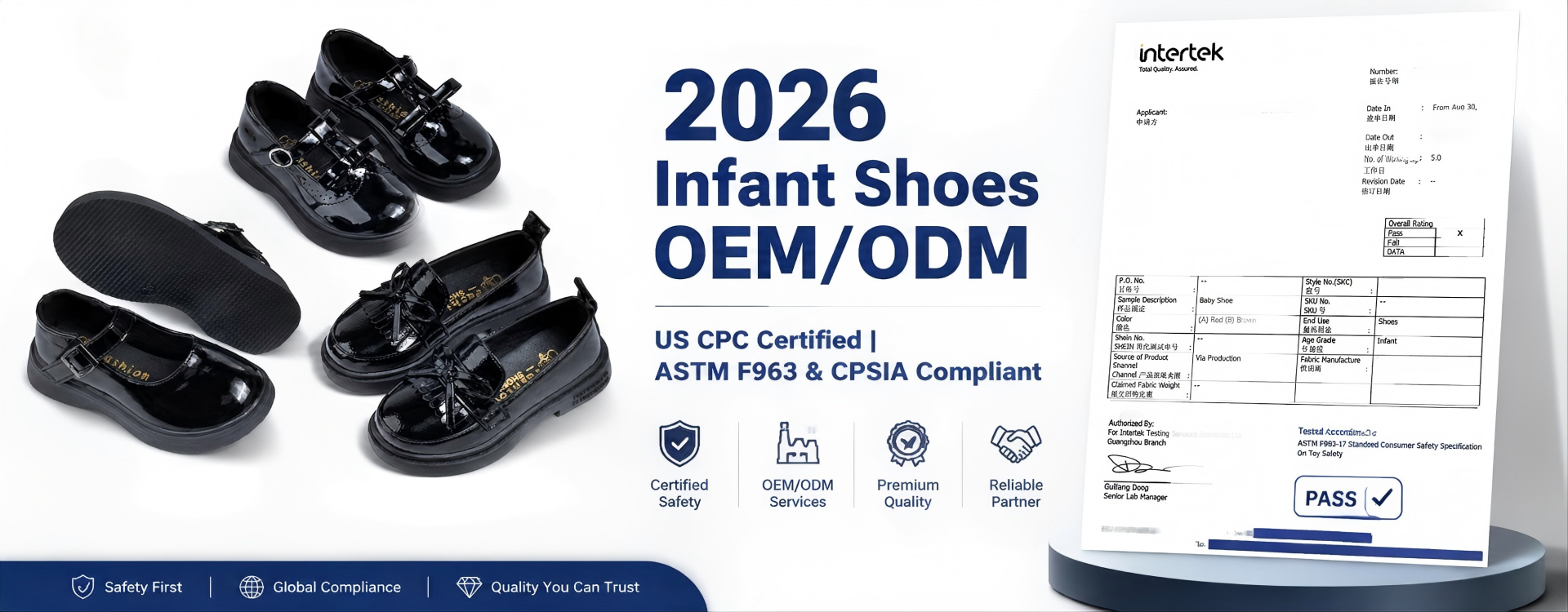
The Children's Product Certificate, commonly referred to as CPC certification, is mandatory for all children's products—including baby shoes—sold in the United States. The CPC is not a certificate issued by a government body; rather, it is a self-issued document backed by third-party lab test results that demonstrates compliance with applicable CPSIA (Consumer Product Safety Improvement Act) requirements.
For baby shoes specifically, a valid CPC must address:
- Lead content limits: Total lead content in any accessible component may not exceed 100 ppm (parts per million).
- Lead in surface coatings: Paint and surface coatings on baby shoes are limited to 90 ppm of lead.
- Phthalates restrictions: Certain phthalates (DEHP, DBP, BBP, DINP, DIDP, DnOP) are permanently banned in children's products at concentrations above 0.1% in accessible plasticized parts.
- Small parts hazard: For shoes intended for children under 3 years old, components such as buttons, decorative studs, or detachable insoles must pass small parts testing to prevent choking hazards.
- Tracking label: Every pair of baby shoes and its packaging must bear a permanent tracking label that identifies the manufacturer, production date, and batch number.
Key takeaway for B2B buyers: When evaluating a factory, do not simply ask "Do you have CPC?" Instead, request to see the underlying third-party test reports from CPSC-accredited laboratories. A compliant supplier should be able to produce test reports covering lead content, phthalates, and mechanical safety for each product SKU you intend to source. At Jiezu Baby, we maintain current lab reports for every material combination in our baby shoe catalog and can issue CPC documents within 24 hours of order confirmation.
2. BSCI: The Social Compliance Backbone
BSCI certification is not a product safety standard—it is a social compliance audit system that evaluates working conditions, labor rights, and environmental management within manufacturing facilities. For many European and North American buyers, BSCI certification is a prerequisite for even beginning a supplier relationship.
The BSCI audit, conducted by accredited third-party firms such as SGS, Bureau Veritas, or TÜV, evaluates factories against the BSCI Code of Conduct, which aligns with International Labour Organization (ILO) conventions. Key areas assessed include:
- Forced labor and child labor prohibition: Zero tolerance for any form of forced, bonded, or child labor in any part of the supply chain.
- Freedom of association: Workers' rights to form and join trade unions and engage in collective bargaining.
- Occupational health and safety: Adequate ventilation, fire safety equipment, emergency exits, personal protective equipment, and documented safety training.
- Working hours and wages: Compliance with local labor laws on maximum working hours, overtime compensation, and minimum wage requirements.
- Environmental protection: Waste management, chemical handling procedures, and energy efficiency practices in the production process.
BSCI audit results are graded on a scale from A (Outstanding) to E (Unacceptable). Most reputable B2B buyers expect their suppliers to maintain a BSCI audit grade of C or higher, with a valid audit cycle (typically reviewed every two years).
Key takeaway for B2B buyers: A factory's BSCI report reveals the operational integrity behind the product. A supplier with a strong BSCI track record is statistically less likely to experience production disruptions, labor disputes, or quality inconsistencies. Ask for the full audit report—not just the certificate—and pay attention to the corrective action plan if any findings were flagged. Jiezu Baby has consistently achieved BSCI audit grades of B or above, with full transparency on all audit documentation available to our trade partners upon request.
3. REACH: The EU's Chemical Safety Framework
For buyers importing baby shoes into the European Union, REACH compliance is legally mandatory. REACH (Registration, Evaluation, Authorisation and Restriction of Chemicals) is the EU's comprehensive regulation governing chemical substances in consumer products. This is arguably the most stringent chemical safety regulation for children's footwear in the world.
Under REACH, baby shoes must comply with:
- Annex XVII restrictions: Specific chemical substances and substance groups that are restricted in consumer products. For baby shoes, critical restricted substances include:
- Certain phthalates (same families covered by CPSIA)
- Azo dyes releasing carcinogenic aromatic amines (critical for dyed textiles and leather)
- Dimethylfumarate (DMF), an anti-mold agent sometimes found in footwear packaging
- Chromium VI in leather materials
- Formaldehyde in textile components
- Organotin compounds used as stabilizers in PVC and PU materials
- SVHC (Substances of Very High Concern): Manufacturers and importers must inform the European Chemicals Agency (ECHA) and downstream customers if any article contains an SVHC above 0.1% weight by weight. The SVHC candidate list is updated twice a year and now includes over 240 substances.
- Article 33 communication duty: Suppliers must, upon consumer request within 45 days, provide information about SVHCs present in their products—a requirement that flows directly from factory to brand to retailer.
Key takeaway for B2B buyers: REACH compliance cannot be retrofitted. A baby shoe that fails REACH testing after production is essentially unsellable in the EU, representing a total loss on materials, labor, and shipping. The only reliable approach is to work with a manufacturer that integrates REACH compliance into material procurement, not just final product testing. At Jiezu Baby, all raw materials entering our production lines—from leather to adhesives to thread—are pre-screened against the REACH SVHC candidate list by our in-house laboratory before any cutting or assembly begins.
Beyond the Big Three: Supplementary Baby Shoes Safety Certifications Worth Knowing
While CPC, BSCI, and REACH form the backbone of any serious baby shoe compliance program, several additional certifications can strengthen your market position and address specific regional or retailer requirements.
CA Prop 65 (California Proposition 65)
Even if your baby shoes are sold outside California, many large U.S. retailers (Walmart, Target, Amazon) require CA Prop 65 compliance across their entire supply chains. Proposition 65 maintains a list of over 900 chemicals known to cause cancer, birth defects, or reproductive harm, with exposure warning requirements that are stricter than federal CPSIA thresholds in some categories. Baby shoes containing materials like synthetic leather or EVA foam should be tested against the Prop 65 chemical list to avoid warning-label requirements that can deter consumers.
OEKO-TEX Standard 100
OEKO-TEX Standard 100 is a globally recognized certification for textile products tested against harmful substances. While technically voluntary, OEKO-TEX certification for baby shoe textiles (uppers, linings, insoles) provides a powerful marketing differentiator and serves as independent third-party validation of chemical safety claims. Products certified under OEKO-TEX Product Class I (the strictest class, designed for babies and toddlers) have undergone testing for over 100 regulated and non-regulated substances, including many that are not yet restricted by mandatory legislation.
ISO 9001 and ISO 14001
While these are management system certifications rather than product safety certifications, ISO 9001 (Quality Management) and ISO 14001 (Environmental Management) signal a factory's commitment to consistent processes and environmental responsibility. For baby shoe buyers placing high-volume, repeat orders with strict delivery timelines and quality tolerances, a factory's ISO 9001 certification provides assurance that production processes are documented, monitored, and continuously improved.
Sedex SMETA Audit
For buyers in the UK and Commonwealth markets, the Sedex Members Ethical Trade Audit (SMETA) is often preferred over or required alongside BSCI. SMETA evaluates labor standards, health and safety, environment, and business ethics using the Ethical Trade Initiative (ETI) Base Code. Many UK high-street retailers specifically require SMETA audit evidence from their footwear suppliers.
How to Verify Baby Shoes Safety Certifications: A Practical Due Diligence Checklist
Too many B2B buyers have learned the hard way that a PDF certificate is not the same as genuine compliance. Fabricated or expired certifications are a real risk in the footwear sourcing industry, particularly when dealing with trading companies that subcontract production to uncertified factories.
Here is a practical verification checklist you can use during supplier evaluation:
1. Validate CPC Documentation
- Confirm the testing laboratory: Cross-reference the lab name and report number with the CPSC's list of accredited laboratories. A legitimate report will come from a lab like Intertek, SGS, Bureau Veritas, or TÜV Rheinland.
- Check product specificity: The test report should explicitly reference the product name, style number, and material composition. Reports that cover generic "children's shoes" without specific SKU identification are a red flag.
- Verify the test date: Consumer product testing standards evolve. A CPC based on a test report older than three years may not reflect current CPSIA requirements. Ask for reports dated within the last 18 months.
- Match the tracking label: The CPC document must reference the same manufacturer name and address that appears on the product's tracking label. Mismatches indicate potential subcontracting without disclosure.
2. Authenticate BSCI Audit Reports
- Check the BSCI platform directly: Valid BSCI audits are recorded in the amfori BSCI platform (accessible to amfori members). Ask your supplier for their DBID (DataBase ID) number and verify the audit status, grade, and validity period.
- Review the scope: The audit scope should clearly state that the audited facility produces baby or children's shoes and that the audit covered all production areas—cutting, stitching, assembly, packing, and warehousing.
- Examine the corrective action plan: A clean audit with zero findings is unusual and may indicate a superficial audit. A credible BSCI report will typically include minor findings with documented corrective actions, demonstrating the factory's commitment to continuous improvement.
3. Evaluate REACH Compliance Evidence
- Request material-level test reports: Comprehensive REACH compliance is demonstrated through test reports for individual materials (upper leather, lining fabric, sole compound, adhesive, thread, dye), not a single "REACH certificate" for the finished shoe.
- Verify SVHC screening frequency: Ask how often the factory re-screens its material supply chain against the ECHA SVHC candidate list. Since the candidate list updates twice a year, a responsible manufacturer should have a documented process for periodic re-evaluation.
- Request a Declaration of Conformity: While not legally sufficient on its own, a signed EU Declaration of Conformity from the manufacturer—stating that the products meet applicable REACH requirements—adds a layer of documentary protection for importers.
4. Schedule an On-Site Audit
No amount of paperwork can replace a physical factory visit. If an in-person visit is not feasible, commission a third-party quality assurance firm to conduct an on-site audit. The auditor should verify that:
- The chemical storage and handling areas match the documented procedures
- The in-house or contracted testing laboratory has calibrated equipment and trained staff
- Production line workers are using the materials specified in the test reports
- The tracking label system is implemented consistently across all production batches
The Cost of Non-Compliance: Why Baby Shoes Safety Certifications Are a Business Investment
Some B2B buyers treat safety certifications as an added cost to be minimized. This mindset is dangerously short-sighted. The financial and reputational consequences of non-compliance far outweigh any upfront savings from working with an uncertified supplier.
Consider the real-world risks:
- U.S. CPSC recalls: In 2023, the CPSC issued over 30 recalls for children's products, with an average direct cost per recall exceeding $500,000 when including logistics, legal fees, and retailer chargebacks. Baby shoes with lead or phthalate violations have appeared in multiple recall announcements over the past five years.
- EU RAPEX alerts: The EU's Rapid Alert System for dangerous non-food products (RAPEX) regularly flags children's footwear containing restricted chemicals. A RAPEX notification triggers mandatory withdrawal from all EU member states and is publicly visible, damaging brand reputation indefinitely.
- Amazon and marketplace delistings: Major e-commerce platforms now require CPC documentation before listing children's footwear products. Sellers who cannot produce valid certificates face immediate delisting, inventory stranded in FBA warehouses, and loss of selling privileges.
- Retailer chargebacks and contract termination: Large retail chains include compliance warranties in their vendor agreements, with penalties for non-compliance that can include full refund of wholesale value plus logistics costs. Repeated issues typically result in permanent delisting as an approved vendor.
Conversely, working with a fully certified manufacturer from day one offers measurable business advantages:
- Faster speed-to-market: Pre-existing certification documentation means you can list products on regulated platforms immediately, rather than waiting weeks for third-party testing after samples arrive.
- Reduced inspection risk: Customs authorities in the U.S. (CBP) and EU target shipments from uncertified or unknown manufacturers for intensive inspection. Shipments accompanied by complete, current certification documentation face fewer delays.
- Stronger retail partnerships: National retail chains maintain approved vendor lists that require verified compliance documentation. Certified suppliers gain access to these lists, opening doors to high-volume wholesale business.
- Consumer trust and brand equity: In a market where parents are increasingly researching product safety before purchase, the ability to cite specific, verifiable certifications directly on product pages and packaging builds trust that translates into higher conversion rates and lower return rates.
How Jiezu Baby Ensures End-to-End Compliance for Your Baby Shoe Orders
At Jiezu Baby, we view safety certifications not as an endpoint but as an ongoing commitment embedded in our daily operations. Our compliance infrastructure is designed to give B2B buyers complete confidence in every shipment.
In-house material testing laboratory: We operate a dedicated chemical and mechanical safety testing lab within our Quanzhou facility, equipped with XRF analyzers for lead screening and calibrated testing apparatus for small parts, sharp edges, and flammability. Every incoming material lot is tested before entering production.
Dual certification strategy: We maintain simultaneous compliance with both U.S. (CPC + CPSIA) and EU (REACH) regulatory frameworks as our baseline standard. This means that regardless of your target market, our baby shoes meet or exceed the most stringent requirements globally. We also maintain active BSCI, Sedex SMETA, ISO 9001, and ISO 14001 certifications, audited annually by recognized third-party bodies.
Pre-certified product catalog: Our entire standard baby shoe catalog is pre-tested and pre-certified. When you select styles from our existing range, we can provide complete CPC, REACH test reports, and BSCI audit documentation within one business day. For custom designs using new materials, our in-house lab conducts rapid pre-screening during the sampling phase, with full third-party certification completed before bulk production authorization.
Transparent documentation portal: Every Jiezu Baby trade partner receives access to our online compliance portal, where you can download current certifications, test reports, and audit documents for any SKU in your order history—available 24/7, without needing to email a sales representative.
If you are also sourcing other categories, you may find our related articles useful:
- Baby Shoes Material Guide: Leather vs. PU vs. Canvas vs. Organic Cotton — a deep dive into material selection from both safety and commercial perspectives.
- Seasonal Sourcing Calendar for Baby Footwear: When to Order for Maximum Margins — plan your procurement timeline around global trade cycles and seasonal demand patterns.
- Sustainable Baby Shoes: The Eco-Friendly Sourcing Opportunity for 2026 — explore how organic cotton, recycled soles, and eco-certifications are reshaping the B2B baby footwear landscape.
About Jiezu Baby — Your Certified Baby Shoe Manufacturing Partner
Jiezu Baby is a specialized B2B manufacturer of baby and toddler footwear based in Quanzhou, Fujian, China—the heart of global footwear production. Since our founding, we have served wholesalers, distributors, private-label brands, and retail chains across more than 30 countries, delivering over 2 million pairs of certified baby shoes annually.
Our certifications include CPC and CPSIA compliance for the U.S. market, full REACH compliance for the EU, BSCI (Grade B), Sedex SMETA 4-Pillar, ISO 9001:2015, and ISO 14001:2015.
We offer:
- MOQ as low as 500 pairs per style with flexible color and size breakdowns
- Custom design and private-label services with in-house pattern engineering and material sourcing
- Rapid sampling: 7–10 business days for new designs using our digital pattern library
- Typical production lead time: 25–35 days after sample approval
- FOB Xiamen or CIF shipping to major ports worldwide
- Complete compliance documentation provided with every shipment at no additional cost
Ready to source certified baby shoes with complete peace of mind?
Contact our international trade team today to request our current catalog, compliance documentation, and competitive FOB pricing:
- Email: info@babykidshoes.com
- Website: www.babykidshoes.com